
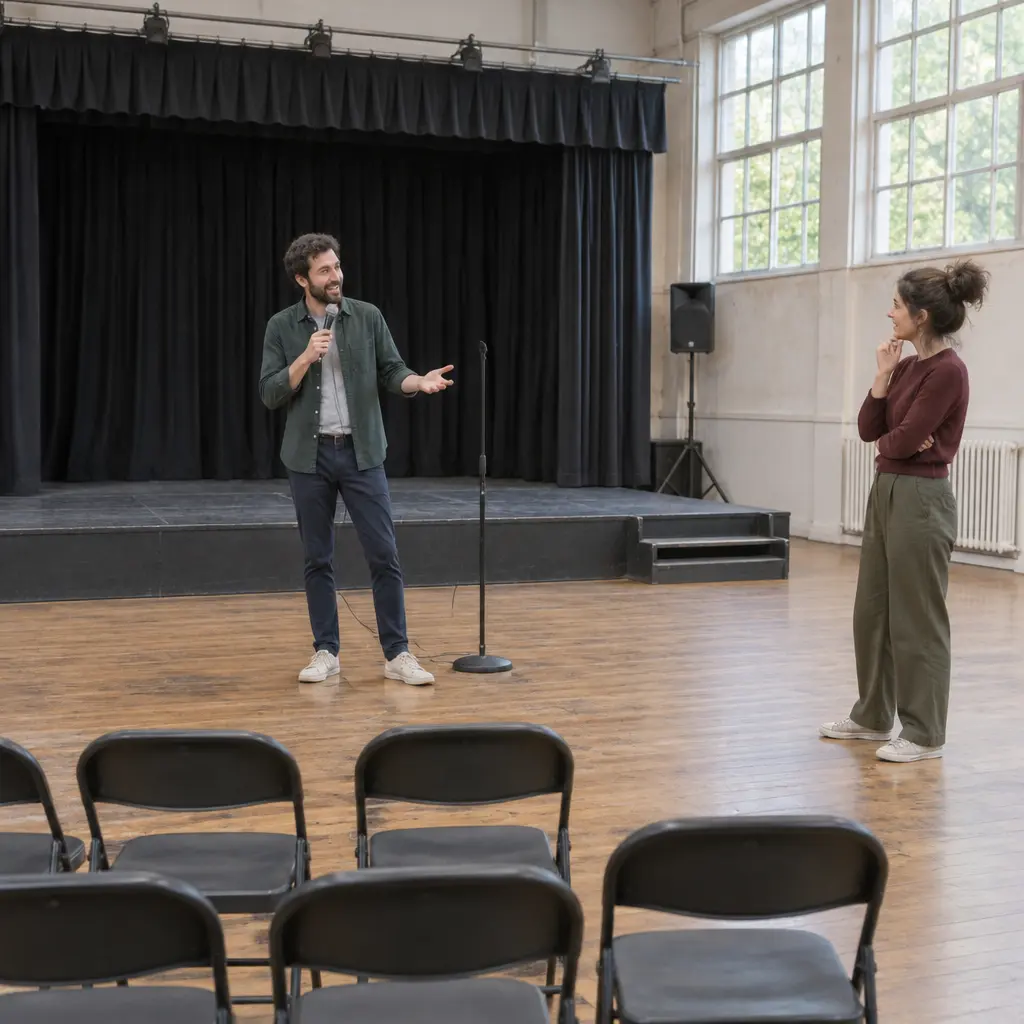
Improv and stand-up comedy are both live performance arts, but they train performers for different kinds of uncertainty. Improv practice develops listening, collaboration, and the ability to make scenes from unscripted offers; stand-up practice develops a performer’s original material through writing, repeated delivery, and revision in response to audiences. The distinction is not absolute: improvisers may rehearse formats, and stand-ups may improvise with a crowd. Still, the training methods reflect different goals—building a scene together versus shaping and performing a set. Understanding those differences helps performers choose useful exercises and audiences recognize the work behind apparently spontaneous comedy.
Training methods define the difference between improv and stand-up
Improv training is the structured practice of creating characters, scenes, and stories in the moment, typically in response to other performers. Stand-up training is the practice of developing and delivering a comic set, usually built from the performer’s own observations, jokes, and stories. These are practical definitions rather than one universal syllabus: schools and performers vary in terminology and technique. The key difference is the unit being trained. Improvisers work on responsive scene-making; stand-ups work on authored material and its performance.
The distinction matters because both forms depend on audience attention, but the performer’s immediate task differs. In an improv scene, an audience response can influence what happens next. In a stand-up set, the performer generally decides what material to present and in what order, while using laughter, silence, or interaction as feedback. The National Endowment for the Arts’ Survey of Public Participation in the Arts tracks participation across arts activities, including comedy-related live performance, but it does not offer a direct national comparison of improv and stand-up training outcomes. Accordingly, claims about which form is more popular or effective should not be inferred from those broad participation measures.
Improv trains shared scene-building
In improv, performers accept and develop what their partners contribute—a practice widely taught through the principle often summarized as “Yes, and.” The principle does not mean agreeing with every real-world claim; in a scene, it means treating a partner’s offer as usable material and adding something that moves the action forward. Training may include short-form games with rules and prompts, long-form scenes that build into a larger structure, character work, and group exercises in focus and timing.
The Upright Citizens Brigade’s published improv curriculum and other school-based programs illustrate how classes can progress from basic scene work toward longer forms and ensemble performance. Exercises commonly ask performers to listen closely, make specific choices, avoid blocking a partner’s offer, and discover a scene’s relationship or situation through action. These skills are interdependent: a clear offer gives a partner something to build on, while attentive listening helps the scene feel coherent rather than like a sequence of unrelated jokes.
Stand-up trains authored material and delivery
Stand-up comedy training focuses on generating, shaping, and performing material for an audience. A joke may be examined for its premise, setup, turn, wording, rhythm, and final punchline; a story may be shaped around detail, escalation, and a comic payoff. These labels are useful craft terms, not a formula that every successful bit must follow. Performers also work on stage presence, vocal clarity, transitions, pacing, and handling pauses or audience interaction.
Unlike an improv scene, a stand-up set can be revised between performances. Comedians often test a new idea in a short set, observe whether the audience follows it and where laughter occurs, then adjust wording, timing, or structure. This is a form of iterative performance practice, not a controlled scientific experiment: the response can vary with the venue, crowd, performer, and order of jokes. There is no reliable universal statistic for how many times a joke must be tested before it is “finished.”
Practice routines build different comedy skills
Because improv relies on moment-to-moment exchange while stand-up relies more heavily on prepared material, the two disciplines use different practice loops. Improv rehearsals commonly create repeated opportunities to respond under changing conditions. Stand-up practice commonly moves from writing to stage testing and revision. Both forms benefit from repetition, reflection, and deliberate attention to what is not working—but their feedback is applied differently.
Improv exercises strengthen listening and adaptability
Improv drills isolate skills that can otherwise be difficult to notice in a full scene. A group might practice repeating or clarifying a partner’s contribution, establishing a location through behavior, or creating a scene with minimal dialogue. Repetition builds attention to offers and helps performers respond specifically rather than reaching for a disconnected punchline. Group rehearsal also makes ensemble habits visible: performers can examine whether they share focus, support a partner’s choice, and keep the scene understandable.
A typical rehearsal sequence might begin with warm-ups, move into focused exercises, and finish with scenes or a performance-style run. The exact schedule depends on the company or class; there is no standard number of weekly training hours across the improv field. The value of this format is its variety: performers practice responding to partners, constraints, and changing scene circumstances rather than memorizing a single fixed outcome.
Stand-up exercises strengthen writing and revision
Stand-up practice often begins away from the stage. Performers write down observations, personal experiences, opinions, or comic premises, then look for an angle that makes the idea distinctive. They may edit for economy, read material aloud to hear its rhythm, and arrange individual bits into a set with deliberate transitions. Recording a performance can help a comedian review pacing and wording, although a recording cannot explain by itself why a particular audience reacted as it did.
Open mics and booked sets provide opportunities to try material before live audiences. A comedian can note whether a premise is understood, whether a laugh arrives earlier or later than expected, and whether the next line weakens the bit. The feedback is useful but noisy: a quiet room does not automatically prove that a joke is bad, just as a strong laugh does not establish that it will work in every setting. Revision requires judgment as well as audience response.
Performance conditions shape how training is applied
The stage environment reinforces the difference between the forms. Improv performers typically share responsibility for creating the event, so training emphasizes attention to partners and the group’s emerging structure. Stand-up performers generally hold the floor alone, so training emphasizes command of the set and a clear relationship with the audience. In practice, the boundary is porous: an improviser may perform a solo monologue, and a stand-up may incorporate crowd work or spontaneous responses.
Ensemble performance makes collaboration a core improv skill
An improv performer must contribute without taking over. Training therefore includes awareness of who has focus, when to enter, and how to support a scene partner’s character or discovery. In long-form improv, performers may also learn to connect scenes through recurring themes, relationships, or patterns. The audience sees a single performance, but its coherence depends on many small choices made collaboratively.
This ensemble emphasis makes improv training relevant beyond comedy, including communication workshops and some applied-theatre programs. However, transferable benefits should be described carefully: a classroom exercise may support practice in listening or collaboration, but it does not guarantee measurable improvement in every workplace or social setting. The strongest claim is that improv directly rehearses responsive interaction within the activity itself.
Solo performance makes comic voice and set control central to stand-up
A stand-up performer must sustain audience attention while making choices about tone, pace, and material. Training may include developing a recognizable comic perspective, arranging jokes into a set, and managing the transition between scripted lines and unscripted crowd interaction. The performer’s voice is not merely vocal sound: it also includes the point of view, persona, and selection of details that make the material feel individual.
The solo format also changes how a performer responds to a difficult moment. An improviser can hand focus to a partner or use a scene development to redirect attention; a stand-up usually has to make the next choice alone. Some comedians acknowledge a stumble, return to prepared material, or engage the room. Those responses are trainable performance decisions, but they are not guaranteed fixes for every audience or venue.
Choosing a training path depends on the performer’s goal
A performer who wants to create characters and stories collaboratively may begin with improv classes, while someone focused on personal material and solo stagecraft may prefer stand-up workshops and regular open-mic practice. Neither route is exclusive. Improv can help stand-ups become more comfortable with spontaneous interaction, and stand-up writing can help improvisers sharpen premises and comic point of view. The useful question is not which form is superior, but which skills the performer wants to practice next.
-
Choose improv practice to emphasize listening, collaboration, character choices, and scene development.
-
Choose stand-up practice to emphasize writing, editing, solo delivery, and testing material with audiences.
-
Combine the forms when the goal includes both responsive performance and stronger authored material.
For either discipline, a practical starting point is to find a reputable class or performance community, observe how feedback is given, and practice consistently in supportive settings. Beginners should treat early performances as learning opportunities rather than as definitive judgments of talent. A chart comparing the two training loops would show improv moving from partner offers to scene response and group reflection, while stand-up moves from idea generation to drafting, live testing, and revision.
Conclusion: improv and stand-up train complementary abilities
Improv training develops shared scene-building through listening, adaptability, and ensemble practice. Stand-up training develops authored comedy through writing, revision, delivery, and audience testing. Their rehearsal routines reflect these different demands, while performance conditions determine whether the performer’s main responsibility is to build with partners or guide a solo set. The approaches can also complement one another: performers can use improv to practice responsiveness and stand-up to strengthen comic voice and structure. To explore further, compare introductory classes, watch live performances closely, and keep a record of what each form asks performers to do.
Sources: Upright Citizens Brigade, Training Center and Improv Curriculum, https://ucbcomedy.com/training/; National Endowment for the Arts, Survey of Public Participation in the Arts, https://www.arts.gov/impact/research/arts-data-profile-series/adps-18; Encyclopaedia Britannica, Improvisation, https://www.britannica.com/art/improvisation-theatre; Encyclopaedia Britannica, Stand-up comedy, https://www.britannica.com/art/stand-up-comedy