
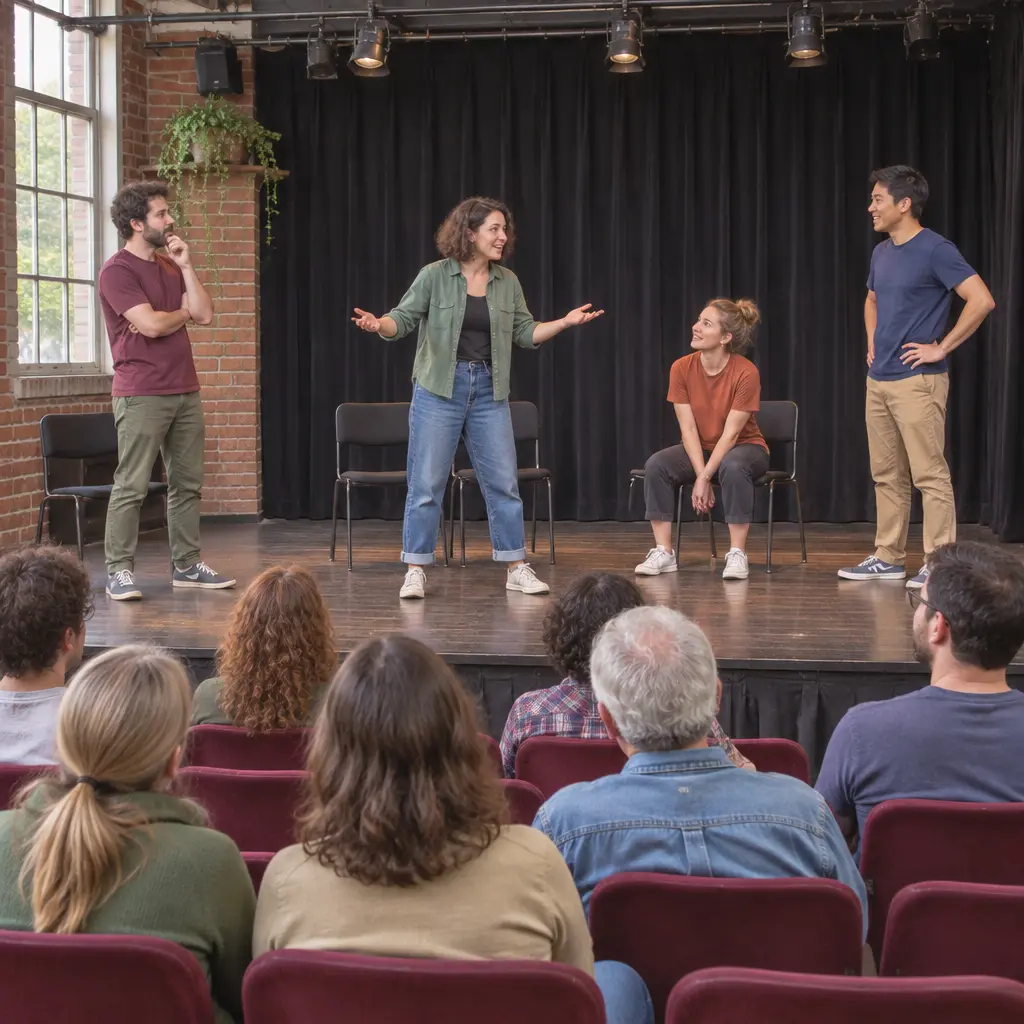
Improv shows are live performances in which actors create scenes, characters, and dialogue in the moment, often using audience suggestions as a starting point. They feel different every time because performers respond to changing prompts, make fresh choices, and build on one another’s ideas rather than follow a fully scripted sequence. That variation is part of the form’s appeal: research on live arts audiences, including the National Endowment for the Arts’ Survey of Public Participation in the Arts, tracks attendance as a significant part of cultural life, while improv offers a particularly immediate reason to return—the next performance cannot be exactly the same as the last. The differences come from audience input, ensemble chemistry, improvisational rules, venue conditions, and the unpredictable energy of live performance.
How Audience Participation Changes Improv Shows
Audience participation is the contribution spectators make to an improv performance, usually by offering a word, location, occupation, relationship, or other prompt. The suggestion gives performers a starting point; it does not usually dictate the whole scene. The Applied Improvisation Network describes applied improvisation as using improvisational practices in settings beyond performance, while theatrical improv uses related skills—listening, accepting offers, and building collaboratively—to create live scenes.
Audience Suggestions Create Different Starting Points
A suggestion can change the first image or premise of a scene. “A lighthouse” might inspire a lonely keeper, a supernatural mystery, or a comedy about a faulty lamp. Because performers interpret the prompt rather than reproduce a fixed answer, even the same suggestion can lead to a different scene on another night. Long-form formats may use one audience prompt to inspire several connected scenes, while short-form games often use prompts for quick, self-contained rounds.
Audience Energy Influences the Room
The audience affects a show not only through suggestions but also through attention, laughter, silence, and timing. A lively crowd may encourage performers to extend a comic beat; a quieter room may make a subtle or emotionally focused scene easier to sustain. This is a feedback loop, not a guarantee that one audience is “better” than another: performers adapt to the response they receive, and the audience reacts to the choices unfolding onstage.
That audience-to-stage exchange is one reason the same troupe can produce noticeably different nights. It connects directly to the next source of variation: the performers themselves.
How Ensemble Chemistry Shapes Improv Shows
Ensemble chemistry is the way performers’ habits, trust, timing, and creative choices interact during a performance. Improv educator Keith Johnstone, whose book Impro helped popularize modern improvisation training, emphasizes spontaneous interaction and attentive response. In practice, performers build scenes by noticing what a partner contributes and treating it as meaningful material, rather than trying to control every moment alone.
Listening and “Yes, And” Build Scenes
“Yes, and” is a common improv principle: accept the reality another performer has introduced, then add information that develops it. It does not mean agreeing with every real-world claim; it means supporting the fictional situation so the scene can progress. One performer might establish that two characters are lost in a museum, and a partner can accept that setting while adding a new detail, such as a security guard who recognizes them.
The principle makes scenes coherent without making them predictable. Different partners notice different details, and the same performer may make different choices depending on what a scene partner offers. The result is a changing combination of character relationships, tone, and story direction.
Trust and Risk Affect Performance
Trust lets performers take creative risks because they expect fellow actors to support an unexpected choice. A group with a long shared history may develop recurring rhythms or comic sensibilities, but it can still surprise itself when someone introduces a new character or emotional turn. Improvisation also involves recovering from uncertainty: a missed cue or an unusual audience response can become part of the scene if performers respond constructively.
These interpersonal choices happen within a format. The rules of that format determine how much of the evening changes and how the changing material is arranged.
How Improv Formats Make Each Show Distinct
An improv format is the structure that guides a performance, including its games, scene length, transitions, and use of prompts. Theatres and training organizations use many formats, but two broad categories help explain why shows vary: short-form improv, built from brief games, and long-form improv, built from extended or connected scenes. These are not rigid opposites; a performance can combine both.
Short-Form Improv Uses Games and Constraints
Short-form improv consists of compact scenes or games with clear rules, such as speaking only in questions or performing a scene in a particular genre. The constraint gives performers a shared challenge and helps audiences quickly understand the game. Since each round can use a different suggestion, cast combination, or comic approach, the sequence of games may feel fresh even when a troupe repeats a familiar format.
Long-Form Improv Develops Connections Over Time
Long-form improv uses a broader structure in which scenes may echo, contrast with, or develop one another. A single suggestion can inspire multiple characters or storylines, and performers decide in the moment which connections to pursue. The format allows themes and relationships to emerge gradually, so a performance can feel more like a collectively discovered play than a string of isolated games.
Format shapes the possibilities, but the performance still takes place in a particular room, on a particular night. Those circumstances supply another layer of difference.
How Venue and Live Conditions Change Improv Shows
Live performance is shaped by the physical and social conditions of the venue: stage size, seating arrangement, sound, lighting, and the audience’s proximity to performers. A close, small room can make reactions feel immediate, while a larger space may encourage broader physical choices and stronger vocal projection. These effects are practical rather than mysterious; performers adjust their delivery to be understood and to connect with the people in front of them.
Room Layout Affects Timing and Interaction
In a theatre-in-the-round setup, performers can be viewed from several directions, so blocking and physical storytelling may differ from a conventional front-facing stage. In an intimate cabaret room, a quick audience exchange may feel natural; in a large auditorium, performers may need to repeat or clarify a prompt. Even laughter changes timing: a strong response can pause a scene, while a softer response may let the dialogue continue without interruption.
A Live Show Cannot Be Fully Reproduced
Theatre is a time-bound event: performers and spectators share the same moment, and the details of that interaction cannot be precisely recreated. The National Endowment for the Arts’ audience research treats attendance at live performing arts as a distinct form of cultural participation. Improv makes the one-time quality especially visible because its dialogue and scene choices are generated in performance. A recording may preserve a particular show, but it cannot make the next audience’s experience identical.
Why the Difference Matters to Repeat Audiences
Variation gives repeat attendance a different value from revisiting a fixed script. A returning audience can recognize performers’ styles while encountering new prompts, pairings, discoveries, and mistakes-turned-into-jokes. The pleasure is not simply surprise: it is watching a group make sense of uncertainty together. That can make improv appealing to people interested in comedy, collaborative storytelling, or the craft of live performance.
A Practical Example: One Prompt, Many Outcomes
Imagine two performances that both begin with the suggestion “train station.” In one, performers might build a fast comedy about missed connections and a confused ticket inspector. In another, the phrase could prompt a quiet scene about a family saying goodbye. The setting is the same, but the cast’s interpretation, audience response, scene partners, and chosen format lead the material elsewhere. This illustrates why a prompt is a catalyst, not a script.
Conclusion: The Sources of Improv’s Changing Experience
Improv shows feel different each time because audience suggestions and reactions influence the starting point, ensemble chemistry shapes what happens next, formats guide how scenes connect, and live venue conditions affect timing and delivery. The result is a performance that can be recognizable in its structure yet new in its details. If you are curious, see the same troupe more than once, try both short-form and long-form shows, and notice how performers turn a simple audience prompt into a shared, unrepeatable event.
Sources: National Endowment for the Arts, Survey of Public Participation in the Arts, https://www.arts.gov/impact/research/arts-data-profile-series/adp-29; Applied Improvisation Network, What Is Applied Improvisation?, https://www.appliedimprovisationnetwork.org/; Keith Johnstone, Impro: Improvisation and the Theatre, Routledge, https://www.routledge.com/Impro-Improvisation-and-the-Theatre/Johnstone/p/book/9780878301171.