
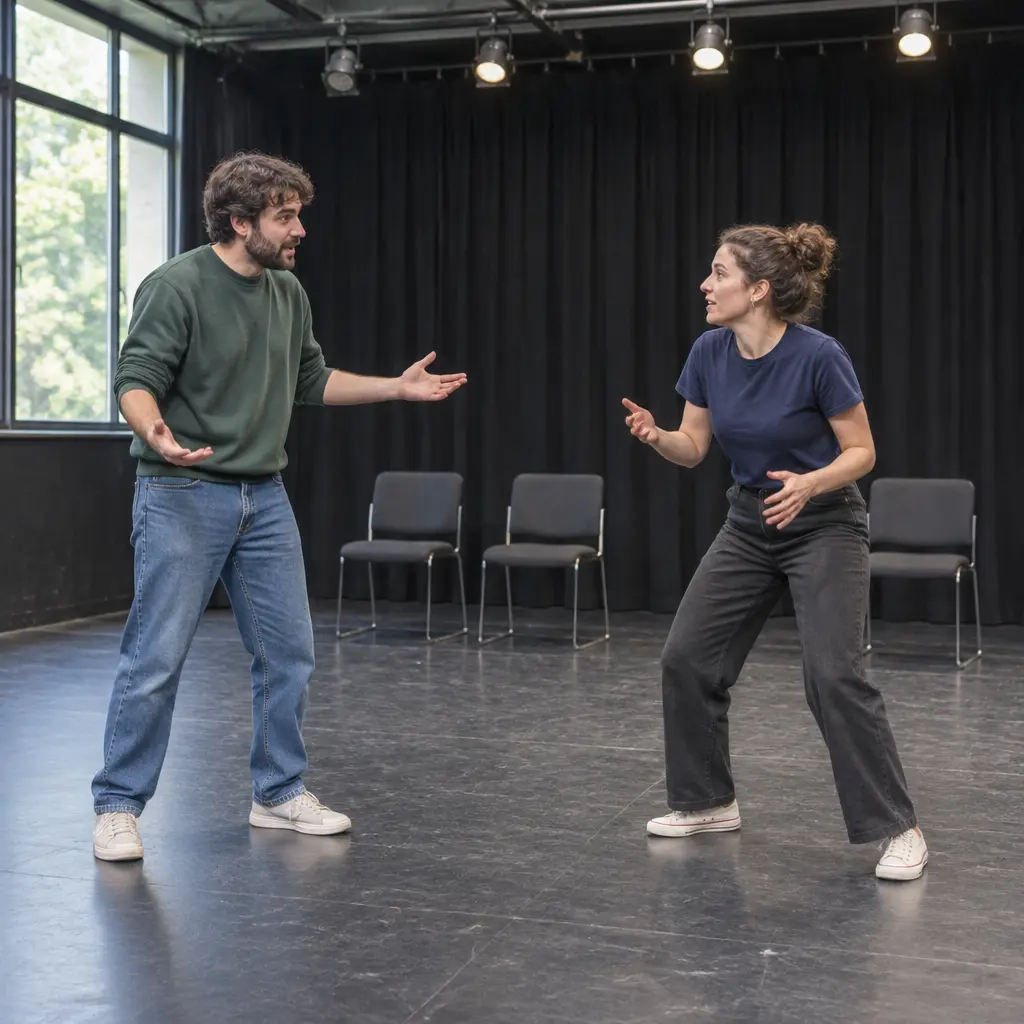
An improvisational theatre show is a live performance built substantially from scenes and dialogue created in the moment, often using audience suggestions or performers’ spontaneous choices. Memorable improv is not simply unpredictable: it combines attentive listening, clear relationships, escalating choices, emotional commitment, and a satisfying sense of shared discovery. Research on live performance and social interaction helps explain why those ingredients matter, while the history of influential groups such as The Second City and the Upright Citizens Brigade shows how spontaneous play can become a recognizable theatrical form. The sections below examine the craft, audience connection, structure, and practical examples behind shows that stay with people.
Build Strong Scenes: Improvisational Theatre Show Craft
A useful working definition of a memorable improvisational theatre show is a performance in which performers transform spontaneous material into scenes that audiences can follow, feel, and recall. There is no single academic or industry-wide definition of “memorable improv”; the term describes an outcome rather than a formal genre. The Association for Applied and Therapeutic Humor, for example, defines improvisation in its applied context as responding creatively to what is happening in the moment. On stage, that response becomes theatre through character, relationship, conflict, and theatrical choices.
The core craft includes several related forms: short-form games with clear rules, long-form improvisation that develops connected scenes, musical improv, and audience-participation formats. Their common challenge is to make novelty legible. A scene can be surprising, but the audience needs enough consistent information to understand who the characters are and why the moment matters.
Active Listening and “Yes, and”
Active listening means treating a partner’s words, behavior, and emotional signals as material to build on. The familiar improv principle “Yes, and” summarizes two actions: accept the reality established by a scene partner, then contribute a new detail. It is a teaching convention, not a guarantee that every offer must be accepted literally; performers can redirect a scene while preserving their partners’ contributions.
This practice makes scenes feel collaborative rather than competitive. If one performer establishes that the characters are stranded at a bus stop, a partner might add that the bus is late because it has become frightened of the rain. That response accepts the setting and introduces a playable complication. In contrast, denying the premise repeatedly forces the scene to restart and can make the audience feel the performers are not listening.
Specificity, Character, and Relationship
Specificity gives a scene recognizable details: a peculiar habit, a precise location, or a strong point of view. Character is the performer’s consistent way of behaving and interpreting events; relationship is the meaningful connection between characters. Together, they turn a generic exchange into a scene with stakes. “Two people are talking” is an abstract premise; “a retired magician is teaching his skeptical granddaughter one last escape trick” gives performers and audience a relationship to track.
The Second City’s history illustrates how improvisation can support character-driven comedy and later scripted work. Founded in Chicago in 1959, the company developed a performance tradition that combined improvisation with revue and sketch material. Its institutional history is a useful example of improv’s capacity to generate distinct voices and recurring themes, rather than relying on disconnected jokes alone.
Escalation and Payoff
Escalation is the meaningful increase of a scene’s tension, consequence, or comic absurdity. A payoff is a later moment that rewards attention to an earlier detail, such as a callback or a decision that resolves a character’s problem. Neither requires a prewritten ending. Performers can create coherence by noticing what the scene has already established and allowing its implications to grow.
A recurring object, phrase, or belief can become a structural thread. If a character insists that every household object is secretly a violin, later scenes can test that belief in increasingly consequential settings. The callback is satisfying because it recalls shared information while changing its meaning. This connects scene craft to the larger question of audience attention: people remember not just isolated surprises but patterns they can recognize and anticipate.
Create Audience Connection: Improvisational Theatre Show Experience
Audience connection is the sense that spectators are witnessing an event shaped by the performers’ attention and the room’s energy. Improv has a distinctive advantage here: the audience knows that the performance is unfolding live, and a suggestion or visible reaction can influence what happens next. Participation is not essential, however. A show can feel immediate through performers’ responsiveness, clear storytelling, and shared laughter even when spectators never speak.
Live performance research offers context for this shared experience. In a 2014 study published in the journal Proceedings of the National Academy of Sciences, researchers compared live and recorded music audiences and found that live performance produced stronger synchronization in measures including heart rate. The study examined music, not improvisational theatre, so it cannot prove that improv has the same effect. It does support the broader point that co-present performance can create measurable forms of collective attention.
Audience Suggestions and Shared Ownership
An audience suggestion is a prompt—such as a location, object, or occupation—that performers use as starting material. A well-handled suggestion gives spectators a sense of contribution without making the performance depend on them. Performers should clarify the request, accept a usable answer, and move promptly into the scene. Too many questions can drain momentum; ignoring a suggestion can make participation feel cosmetic.
The Upright Citizens Brigade Theatre, founded in 1996, helped popularize long-form improv in which an opening idea can inspire a sequence of connected scenes. Its training and performance traditions illustrate one way audience input can become a seed rather than a plot command. In a memorable show, the suggestion is transformed: spectators recognize its influence, but the performers develop it into something more surprising than a literal enactment.
Emotional Variety and the Right to Follow the Scene
Emotional variety means allowing scenes to move beyond a single comic register. A funny show may include tenderness, suspense, embarrassment, or sincerity; these shifts give laughter contrast and make characters feel human. The principle is not that every scene must become serious, but that performers should respond to the emotional reality they have created rather than forcing jokes onto every beat.
Psychologist Robin Dunbar and colleagues reported in a 2012 study that social laughter was associated with an increased pain threshold, which the researchers interpreted as consistent with endorphin release. The study investigated laughter and social bonding, not audience memory or improv specifically. It offers a relevant, limited insight: laughter can be a social experience, and a room laughing together may strengthen the feeling of connection that contributes to a show’s impact.
Trust, Safety, and Responsible Participation
Trust is the expectation that scene partners will support one another’s offers and that performers will handle audience interaction with care. Psychological safety in a performance setting does not mean avoiding all risk or discomfort; it means establishing boundaries, respecting consent, and not making a participant the target of humiliation. Clear hosting, optional participation, and attentive handling of sensitive material help spectators relax into the experience.
This matters artistically as well as ethically. When performers are not preoccupied with protecting themselves from a partner’s choices, they can listen more fully and take imaginative risks. A show’s energy can be bold without treating cruelty as a shortcut to surprise. For audiences, the difference is often apparent in whether a moment feels playfully shared or imposed.
Shape the Whole Evening: Improvisational Theatre Show Structure
A memorable show has a shape, even when its scenes are invented. Structure is the arrangement of openings, scenes, transitions, and endings that helps an audience understand how individual moments belong together. Short-form shows often use a host and a sequence of games; long-form shows may develop one theme or recurring idea across multiple scenes. These are hyponyms—specific formats within the broader category of improvisational theatre—and each creates different expectations.
Structure does not eliminate spontaneity. Instead, it gives performers a framework for making spontaneous choices easier to follow. A clear start, variation in pace, and an ending that acknowledges the evening’s material can make a collection of improvised scenes feel like a complete event.
Short-Form Games
Short-form improv consists of brief scenes or games governed by an easily explained constraint, such as speaking only in questions or building a scene from audience-provided words. The rules create immediate focus and make the format accessible to newcomers. The risk is that a show can feel like a sequence of unrelated exercises if performers and hosts do not create transitions or a unifying tone.
Short-form works especially well when the rules are visible, the rounds move briskly, and the performers’ characters remain more important than the mechanics. A game should be a vehicle for play, not an excuse to abandon the scene’s relationship or stakes. Hosts can help by explaining only what the audience needs and by keeping the performance moving.
Long-Form Improvisation
Long-form improv links multiple scenes through a shared opening, theme, location, character, or pattern. Formats vary, but the audience’s pleasure often comes from recognition: an idea introduced early returns later in a changed context. This format rewards patience and close listening because a small detail may become important several scenes afterward.
The form also makes editing important. Performers may end a scene when its central idea has been explored and transition to another scene before the energy declines. The Upright Citizens Brigade’s published approach to long-form emphasizes connected scenes and patterns, offering a practical example of how recurring ideas can create unity without requiring a conventional plot.
Musical and Audience-Interactive Formats
Musical improv combines spontaneous scene work with improvised lyrics, melodies, or songs. It adds the pleasures and constraints of music: rhythm, repetition, rhyme, and the possibility of a refrain that develops a character’s point of view. Audience-interactive formats, meanwhile, may invite spectators to offer prompts or participate in defined ways. Both can be memorable when the added device deepens the scene rather than distracting from it.
For these formats, accessibility is part of the craft. Performers can briefly explain what the audience is being asked to do, make participation optional, and ensure that people who prefer to watch still receive a complete show. A song or interaction earns its place when it reveals something, changes the scene, or gives the evening a distinctive moment.
Learn from Practice: Improvisational Theatre Show Examples
Real-world examples show that there is no single recipe for success. A compact short-form set can be memorable through pace and shared play; a long-form performance can stand out through recurring themes and emotional development. Across both, the strongest work makes performers’ choices visible enough for an audience to follow while leaving the outcome genuinely uncertain.
The Second City: Improvisation into Revue
The Second City demonstrates how improvisational exercises can contribute to material with a longer life. Its Chicago theatre opened in 1959, and its development of sketch and revue comedy helped establish improv as both a performance practice and a method for generating material. The example is relevant to memorability because audiences may recall not only a single joke but also an ensemble’s recurring perspectives and recognizable style.
Upright Citizens Brigade: Connected Long-Form Scenes
The Upright Citizens Brigade offers a prominent example of long-form training and performance. Its approach foregrounds patterns and relationships among scenes, showing how a suggestion can prompt an evolving set rather than a one-off sketch. For audiences, the reward is often the sense that details noticed earlier have acquired new meaning by the end.
A Practical Evaluation Checklist
After a performance, performers and producers can assess what made the evening land without reducing its value to laughter alone. A simple review can consider whether scenes were easy to understand, whether performers built on one another’s offers, and whether the ending felt connected to what came before.
- Clarity: Could the audience identify the setting, relationship, and central situation?
- Collaboration: Did performers accept and develop one another’s choices?
- Specificity: Were characters and details distinctive enough to recall?
- Variation: Did the show offer changes in pace, format, or emotional tone?
- Coherence: Did callbacks, themes, or transitions make the evening feel connected?
- Care: Was audience participation respectful and clearly optional?
These questions are practical indicators, not a scientific measurement of memorability. A useful visual for a rehearsal or review session would be a simple “show arc” chart: plot scene energy from opening to ending, then mark major callbacks, tonal shifts, and audience-participation moments. It can reveal whether the evening built momentum or repeated the same pace throughout.
Conclusion: What Makes an Improvisational Theatre Show Memorable?
A memorable improvisational theatre show combines strong craft, audience connection, and a coherent shape. Active listening and “Yes, and” help performers build together; specificity, character, escalation, and payoff give scenes substance. Audience suggestions, emotional range, and trust make the event feel shared, while short-form games, long-form structures, and musical formats provide different ways to organize spontaneous material.
The broader lesson is that spontaneity works best when supported by attention and care. For performers, the next step is to rehearse listening, make clear offers, and review how scenes connect. For audiences, watching a show with an eye for callbacks and relationships can reveal the craft behind the surprise. Explore local improv performances or introductory classes to see how these principles change from one ensemble and format to another.
Sources: Association for Applied and Therapeutic Humor, “What Is Humor?” and organizational materials on applied humor, https://aath.org/; The Second City, “Our Story,” https://www.secondcity.com/about; Upright Citizens Brigade, “The Upright Citizens Brigade Comedy Improvisation Manual,” https://ucbcomedy.com/; Reinhard, M., and colleagues, “Synchronization of the Heart Rate with the Vocalizations of Live and Recorded Music,” Proceedings of the National Academy of Sciences, 2014, https://www.pnas.org/; Dunbar, R. I. M., et al., “Social Laughter Is Correlated with an Elevated Pain Threshold,” Proceedings of the Royal Society B, 2012, https://royalsocietypublishing.org/doi/10.1098/rspb.2011.1373.