
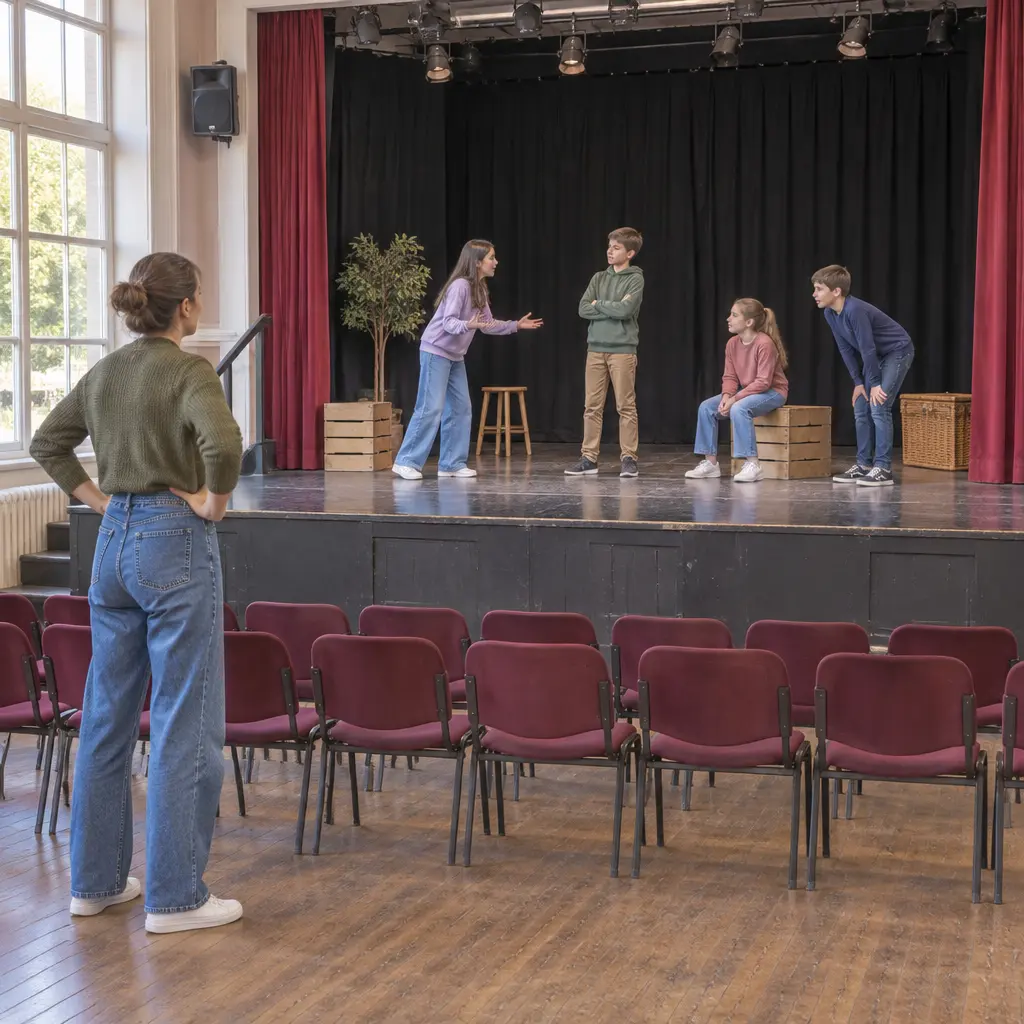
Improvisational theatre, or improv, is live performance built from unscripted scenes that performers create in response to one another and often to audience suggestions. It can be appropriate for families and children when the show is designed for its intended age group, content is clearly signposted, and participation is optional. Improv can offer children opportunities to practise listening, collaboration, flexible thinking, and confidence, but it is entertainment—not a guaranteed developmental intervention—and suitability depends on the performers, venue, and format. The National Endowment for the Arts has reported that children’s arts participation is associated with positive academic and social outcomes, while also cautioning that such associations do not by themselves prove that a particular art form causes those outcomes.
Improvisational theatre’s family suitability depends on content, format, and audience choice
There is no single age at which improv becomes suitable. A child-friendly show usually has clear content boundaries, age-appropriate language and themes, a manageable length, and a welcoming approach to audience involvement. Parents and caregivers can assess these factors before attending rather than relying on the word “improv” alone: unscripted performance can range from gentle storytelling to satire, adult humour, or emotionally intense material.
The scale of children’s engagement with the arts helps explain why this question matters. In its 2012 report The Arts and Achievement in At-Risk Youth, the National Endowment for the Arts summarized research linking sustained arts participation with outcomes including academic achievement and civic engagement. The report concerns arts participation broadly, not improv specifically, and its findings should not be treated as proof that attending an improv show will produce those results. A practical takeaway is more modest: live performance can be a shared cultural experience, and a suitable show may give children a chance to watch people create and cooperate in real time.
Improv’s core attributes support shared family viewing
Improvisation is a performance process in which performers make scenes, characters, or stories without relying on a fully fixed script. The Applied Improvisation Network describes applied improvisation as using improv principles and practices outside traditional performance settings. That definition helps distinguish improv’s transferable methods—such as attentive listening and responding—from claims that every show or exercise has a proven educational effect.
Common forms include short-form games, long-form scenes, improvised storytelling, and audience-prompted performances. Their suitability varies: a fast-paced game show may be easy for young children to follow, while a long-form piece may rely on subtle references or adult themes. Because each performance is different, families should check the company’s description and ask about content, runtime, age guidance, and audience participation.
Short-form games and family-friendly scenes
Short-form improv uses brief games or scenes, often with a clear rule or prompt. The structure can make it accessible to children because they can understand the basic challenge and see how performers build on one another’s ideas. Families can look for shows that explicitly describe their content as suitable for children, avoid humiliating or adult-oriented prompts, and provide a clear way to decline joining in.
Long-form improv and improvised storytelling
Long-form improv develops a connected story or series of scenes over a longer stretch of time. Improvised storytelling may be especially engaging when the performers create a fairy tale, adventure, or story based on child-friendly suggestions. These formats can invite children to notice characters, consequences, and narrative choices, but their longer duration and less predictable content may suit older children better. A preview, sample performance, or conversation with the venue can help families judge the match.
Audience participation and consent
Audience participation means performers invite spectators to contribute a word, idea, or volunteer. It can make a show feel personal, but a child should never be pressured to speak, perform, or disclose personal information. Families can check whether suggestions are taken from the whole room, whether volunteers are invited rather than singled out, and whether the child can remain seated and simply watch. A well-run family show treats participation as an option, not an obligation.
Improv’s social and creative skills are useful possibilities, not guaranteed outcomes
Improv activities are often associated with listening, cooperation, imaginative thinking, and adapting when plans change. These are plausible benefits of a practice that asks people to attend to others and contribute ideas. However, the evidence should be described carefully: research on arts education or drama does not automatically establish that a particular improv class or performance improves every child’s skills. Benefits depend on the quality of instruction, the child’s interest, and whether the environment feels supportive.
Listening, turn-taking, and collaboration
In many improv exercises, a performer must notice what a partner has said or done before adding a response. This creates practice in listening and turn-taking, while ensemble scenes demonstrate how a group can develop a shared idea. For families, a simple observation after the show—such as asking how the actors helped one another—can reinforce the collaborative aspect without presenting a performance as a lesson or test.
Creativity, flexibility, and confidence
Improv invites performers to generate ideas without knowing the ending in advance. That experience may encourage flexible thinking and creative risk-taking, particularly when mistakes are treated as part of the process. Confidence is not an automatic result: some children enjoy performing, while others prefer watching, and both responses are valid. The American Academy of Pediatrics’ clinical report on play describes play as important to children’s development and relationships, but it does not specifically establish improv theatre as a developmental treatment.
Age guidance and content checks make family attendance safer and more enjoyable
Age recommendations are useful starting points, not universal rules. Children differ in attention span, sensory preferences, understanding of jokes, and comfort with unexpected events. Before booking, caregivers can review the show description, ask the venue about potentially frightening or mature content, and find out whether there is an intermission, quiet space, or easy exit. For younger children, a shorter performance with a familiar story format may be a better first experience.
Language, humour, and themes
Unscripted comedy carries a particular content risk: the exact jokes may vary from one performance to another. Organizers of family shows should set clear boundaries around profanity, sexual content, violence, stereotypes, and jokes that target audience members. Caregivers can ask whether performers have a family-show policy and how they respond if a suggestion is unsuitable. A “family-friendly” label is most useful when the company explains what it means.
Sensory needs, accessibility, and comfort
Live theatre may involve amplified voices, sudden sound effects, bright lighting, laughter, and close seating. Families should check practical details such as wheelchair access, reserved seating, relaxed-performance options, and whether the venue permits stepping out and returning. If a child is anxious about being noticed, ask whether performers invite audience members onto the stage. Predictability and a low-pressure exit plan can make a first visit more comfortable.
Family improv programs work best when participation is inclusive and well facilitated
A class differs from a show because children actively take part in games and exercises. A suitable program explains its expectations, offers alternatives to performing in front of the group, and uses age-appropriate activities. Instructors should manage turn-taking and ensure that teasing, exclusion, or unwanted physical contact is not treated as part of the exercise. Families can ask about instructor experience, class size, safeguarding policies, and how the program accommodates different communication and mobility needs.
For example, a children’s theatre workshop might invite participants to invent a character together, take turns adding one sentence to a story, or create a scene using imaginary objects. These activities illustrate how improv principles can be adapted for children; they are not evidence of a specific measured outcome. A thoughtful instructor focuses on participation and shared play rather than rewarding only the loudest or funniest child.
Conclusion: improv can suit families when the experience is age-aware and voluntary
Improvisational theatre can be appropriate for families and children when its format, themes, runtime, and participation expectations fit the audience. Short-form games, improvised stories, and carefully facilitated workshops may offer opportunities to enjoy creativity, listening, and collaboration, while research on arts and play provides broader context rather than proof of improv-specific benefits. Before attending, review the show’s age guidance, ask about variable content and accessibility, and let children choose whether to participate. Families and educators can also consult the National Endowment for the Arts, the American Academy of Pediatrics, and the venue’s own policies when deciding whether a particular performance is a good fit.
Sources: National Endowment for the Arts, The Arts and Achievement in At-Risk Youth: Findings from Four Longitudinal Studies, 2012, https://www.arts.gov/sites/default/files/Arts-At-Risk-Youth.pdf; Applied Improvisation Network, “What Is Applied Improvisation?”, https://www.appliedimprovisationnetwork.org/; Yogman, M. et al., “The Power of Play: A Pediatric Role in Enhancing Development in Young Children,” Pediatrics, 2018, https://publications.aap.org/pediatrics/article/142/3/e20182058/38649/The-Power-of-Play-A-Pediatric-Role-in-Enhancing.