
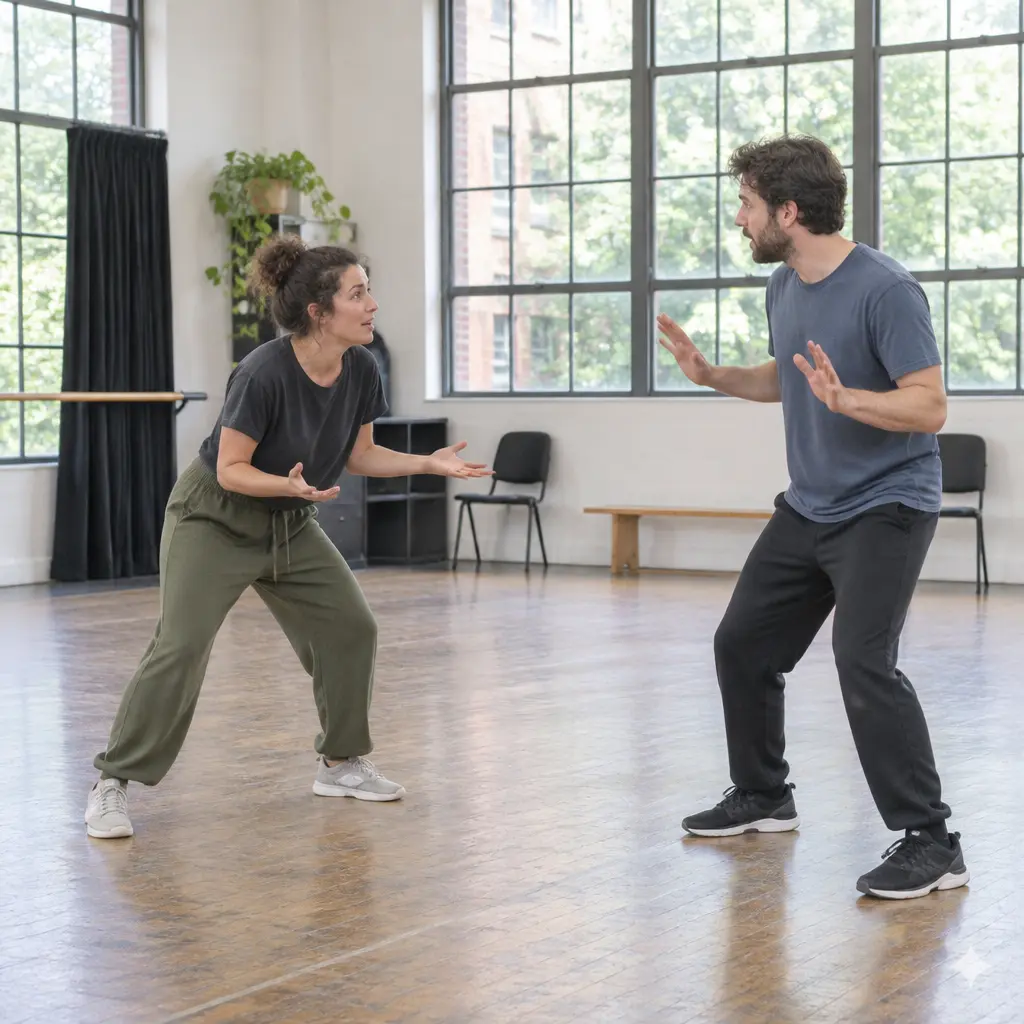
Improv theatre is live performance created substantially in the moment, while scripted theatre follows dialogue and stage directions prepared in advance. The distinction is not simply “spontaneous” versus “rehearsed”: both forms rely on performers’ skills, rehearsal, and collaboration, but they distribute creative decisions differently. Improv places more responsibility on actors to build scenes through listening and shared offers; scripted performance gives a written text a central role, interpreted through direction and rehearsal. Understanding those differences helps audiences, students, and theatre-makers recognize how each form creates structure, risk, and meaning.
Improv Theatre’s Creative Process
Improvisation in theatre means making performance material without a fully predetermined script. The Cambridge Dictionary defines “improvisation” as the act of creating or performing something without preparation, while theatrical practice often includes preparation in the form of games, exercises, agreed formats, or audience prompts. The result is unscripted dialogue and action within a framework, rather than performance without any rules.
A key characteristic is that decisions happen in real time: performers establish characters, relationships, setting, and conflict as the scene unfolds. Theatresports, an influential competitive improv format developed by Keith Johnstone, organizes improvised scenes as short games with rules and audience suggestions. Long-form improv instead links scenes and characters into a more extended structure. These are different approaches to the same core challenge: making coherent theatre while the material is still being discovered.
Short-Form and Long-Form Improv
Short-form improv consists of brief scenes or games, often shaped by a clear constraint, such as speaking only in questions or performing in a particular genre. The constraint gives performers an immediate structure and audiences an easy-to-follow premise. Long-form improv builds a larger piece from an opening suggestion or initial scene, allowing ideas, characters, and themes to recur and develop over time.
Both forms depend on attention and responsiveness, but their pacing differs. Short-form performers typically aim for a quick comic or dramatic payoff; long-form performers have more room to develop relationships and patterns. In either case, an audience suggestion may provide a starting point, but performers shape what follows rather than simply acting out the suggestion literally.
“Yes, and” as a Collaboration Principle
“Yes, and” is a commonly taught improv principle: accept the reality another performer has offered, then contribute information that advances the scene. It is not a demand to agree with every statement in ordinary life; it is a stage technique for avoiding needless rejection of a scene’s premise. Acceptance helps partners establish a shared world, while the added information gives that world forward motion.
The principle illustrates why improv is not merely spontaneous individual wit. A performer must listen closely, notice what has already been established, and make a contribution that supports the ensemble. This collaborative foundation also provides a useful comparison with scripted theatre, where performers respond to one another within dialogue and actions already set down in a play.
Scripted Theatre’s Relationship to the Text
Scripted theatre is performance organized around a written play or other prepared text. The script usually establishes dialogue, characters, and at least some sequence of events, although the amount of stage direction varies. The playwright supplies a durable structure that can be interpreted by directors, actors, designers, and producers across rehearsals and performances.
A script does not make every production identical. Actors make choices about intention, rhythm, gesture, and emphasis; directors shape staging and interpretation; designers create the production’s visual and sonic world. The text constrains some choices while leaving others open. In that sense, scripted theatre is not mechanical recitation but a process of bringing written possibilities to life.
Rehearsal, Interpretation, and Repeatability
Rehearsal is the process of practicing and refining a performance before it meets an audience. In scripted productions, rehearsals help actors learn dialogue and blocking, explore character relationships, and coordinate with the production team. Once a show opens, the performance can be repeated with substantial consistency, though timing, energy, and audience response may vary from night to night.
Repeatability supports careful refinement: a director can adjust a scene, and an actor can test a different emphasis while keeping the play’s basic text intact. The script also provides a reference point for analysis and adaptation. A production may cut lines, change settings, or reinterpret a classic, but those decisions are made in relation to an existing work.
The Script as a Shared Blueprint
A script functions as a shared blueprint for artists working toward one production. It can coordinate dialogue with entrances, exits, scene changes, and technical cues. Playwrights may specify these elements in detail or leave them open to the creative team, so the balance between fixed instructions and interpretive freedom differs from play to play.
That blueprint changes the source of uncertainty. In scripted theatre, performers generally know what happens next, but must make the event feel vivid and truthful. In improv, performers face greater uncertainty about the unfolding material and must create continuity as they go. Both forms therefore require discipline, even though they apply it to different problems.
How Improv and Scripted Performances Differ
The central difference is where the performance’s material comes from and when it is decided. Improv generates much of its dialogue and action during the event; scripted theatre begins with a text established before performance. This affects preparation, performer responsibility, audience interaction, and the degree to which successive performances can vary.
Preparation and Performer Responsibility
Improv performers prepare by developing skills, practicing formats, and learning how to accept and extend offers, rather than memorizing every line of a finished scene. They carry a greater share of the responsibility for creating the immediate story. Scripted actors typically prepare through text study, memorization, rehearsal, and repeated work on character and staging; the playwright’s text supplies a stronger initial structure.
Neither method is effortless. Improv’s apparent ease can conceal extensive training in listening, timing, and ensemble awareness. Scripted work requires performers to make prepared language sound present and purposeful, rather than simply reproducing memorized words.
Variation, Risk, and Audience Influence
Improv scenes can differ significantly from one performance to another because dialogue and plot are created live. This brings creative risk: a scene may develop in an unexpected direction, and performers must adapt without stopping the show. Audience suggestions can influence the starting point in some formats, although the degree of audience participation depends on the company and production.
Scripted performances tend to preserve the same core dialogue and sequence, making them more repeatable. Audiences usually affect the atmosphere through laughter, silence, or applause rather than by supplying plot material. The distinction is not absolute: scripted shows can include audience interaction, and improv companies may use recurring characters, rehearsed structures, or established endings.
Story Structure and Dramatic Control
A scripted play may use a carefully planned arc, with information and turning points arranged by the playwright. Improvised storytelling has to discover its structure in performance. Experienced improvisers create coherence by tracking details, revisiting earlier ideas, and recognizing when a scene needs escalation, a change, or an ending.
This difference can be understood as a shift in timing rather than a simple contrast between order and disorder. Scripted theatre develops much of its structure before opening night; improv builds structure while the audience watches. Both can produce tightly shaped drama or comedy, but they reach that shape through different processes.
Hybrid Forms and Real-World Practice
The boundary between improv and scripted theatre is porous. Some productions combine prepared scenes with improvised dialogue, invite performers to improvise during rehearsals before a script is finalized, or use a scripted framework that permits variation. These hybrid practices show that “scripted” and “improvised” describe methods of creating performance, not mutually exclusive categories.
Improvisation in Rehearsal and Devised Theatre
Directors and theatre companies may use improvisation to explore characters, relationships, or situations before choosing what belongs in a finished script. Devised theatre is created collaboratively by a group, often through workshops, improvisation, and rehearsal-room experimentation. The final production may be scripted, even though improvisation helped generate its material.
This process connects the two forms: improvisation can be a tool for making scripted work, while a written framework can help performers shape an improvised piece. The distinction depends on what audiences encounter and how much material remains open in performance.
Examples Audiences Can Recognize
A short-form improv show built around audience suggestions demonstrates how a premise can be generated in the room and transformed into scenes. By contrast, a production of a published play such as a Shakespearean drama begins with a fixed text, even when its setting, design, or interpretation is newly imagined. A devised production that improvises during development and then performs a set version combines both methods.
A comparison chart could summarize the main distinctions: improv generally creates dialogue live and allows greater performance-to-performance variation; scripted theatre begins with prepared text and tends to offer greater textual consistency. In both columns, rehearsal, interpretation, and ensemble cooperation remain essential.
Conclusion: Two Different Routes to Live Theatre
Improv theatre differs from scripted performance chiefly in when and how its material is created. Improvisers build scenes in the moment through listening, offers, and shared structure; scripted performers interpret a text prepared in advance through rehearsal and production choices. Those differences shape preparation, repeatability, audience influence, and dramatic control, while hybrid and devised practices demonstrate that the forms can also support one another.
Recognizing these methods helps audiences appreciate both the risk of live invention and the craft of interpreting a written play. To explore the distinction further, attend one improv performance and one scripted production, then notice how each establishes its world, develops relationships, and responds to the audience.
Sources: Cambridge Dictionary, “Improvisation,” https://dictionary.cambridge.org/dictionary/english/improvisation; International Theatre Sports Institute, “Theatresports,” https://www.theatresports.org/; Keith Johnstone, Impro: Improvisation and the Theatre, Routledge, https://www.routledge.com/Impro-Improvisation-and-the-Theatre/Johnstone/p/book/9780878301171; Encyclopaedia Britannica, “Theatre,” https://www.britannica.com/art/theatre-art.