
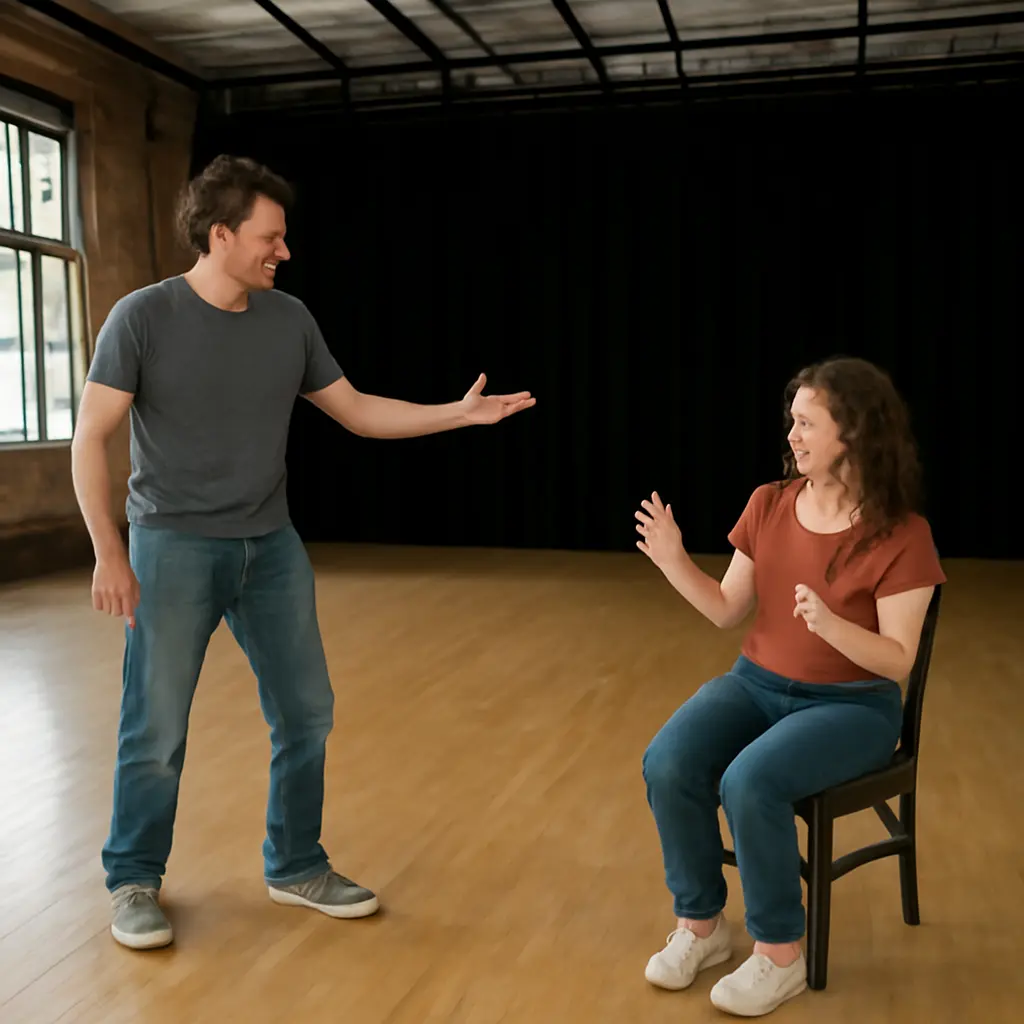
Agreement over contradiction is the comic technique in which performers accept an absurd premise as real while allowing its implications to expose its impossibility. This blend of cooperation and logical mismatch helps audiences follow a scene, anticipate its pattern, and enjoy the surprise when ordinary reasoning collides with an extraordinary claim. Research on humor supports the value of that tension: psychologist Peter McGraw and Caleb Warren’s benign-violation theory describes humor as arising when something seems wrong or threatening but also safe. In comedy, agreement can make a contradiction feel safe enough to explore. From improv’s “yes, and” principle to scripted comic reversals, this article explains how the technique works, why it creates memorable moments, and what performers can learn from it.
Agreement over contradiction: how comic cooperation makes absurdity work
“Agreement over contradiction” is not a standardized academic term; here, it describes a recognizable comic mechanism: a performer accepts the scene’s premise, then responds in a way that makes its internal contradiction increasingly visible. The audience gets two pleasures at once—the coherence of shared play and the surprise of illogic. This matters in improv, sketch, and scripted comedy because a joke depends not only on a surprising idea but also on how clearly the performers help an audience understand it.
The technique has close relatives in improvisation, satire, irony, deadpan, and comic escalation. Its practical importance is especially clear in improv: the comedy-training principle commonly called “yes, and” encourages performers to accept what a scene partner has established and add information. It is a performance convention, not a guarantee that every scene will be funny. When agreement preserves a premise while a contradiction supplies the comic turn, however, the audience can recognize the pattern and enjoy its consequences.
Comic agreement defines the agreement-over-contradiction technique
In this article, agreement over contradiction means accepting a fictional situation at the level of the scene while exposing a conflict in its logic, values, or consequences. The agreement gives the audience a stable premise; the contradiction gives it a reason to laugh. For example, a character may confidently accept that a restaurant is “open to everyone,” then insist that customers must pass a test proving they already know the menu.
This description connects to two established ideas. In improv, “yes, and” names the practice of accepting a contribution and building on it. In humor research, McGraw and Warren’s benign-violation theory proposes that amusement can occur when a perceived violation is also appraised as benign. The theory does not define improv or explain every joke, but it offers a useful lens: performers can make a contradiction comic by keeping it legible, bounded, and safe within the play frame.
The technique usually combines three features: a premise the audience can track, a response that accepts rather than erases that premise, and a discrepancy that becomes more apparent through the response. If a performer simply rejects the premise, the scene may stall. If the contradiction is too obscure, the audience may not notice it. The craft lies in making the mismatch clear without explaining the joke away.
Improv agreement: accepting the scene’s reality
Improv agreement means treating a partner’s contribution as usable information rather than blocking it outright. The familiar “yes, and” shorthand encourages an improviser to accept the established reality and contribute something new. The “and” is essential: passive agreement may leave a scene without momentum, while an added detail gives the premise somewhere to go.
Consider a scene in which one performer says, “The moon has filed a noise complaint.” A partner might answer, “Of course; the ocean has been keeping it up all night.” The second performer accepts the moon’s complaint as part of the fictional world and expands the absurdity through a related image. The contradiction between a celestial body and a mundane civic procedure becomes more vivid because both performers treat it seriously.
Agreement does not require endorsing every idea outside the fictional scene. It is a collaborative stage practice, not a rule that performers must accept harmful, confusing, or unwanted material. Skilled performers can redirect a premise while preserving the scene’s energy and their partners’ contributions.
Comic contradiction: the gap that produces surprise
Comic contradiction is a mismatch between what a scene’s premise appears to mean and what a character’s actions or logic reveal. It may be verbal, such as a character claiming to be “completely honest” while carefully hiding the truth; situational, such as a fire-safety seminar conducted in a burning room; or behavioral, such as a self-proclaimed expert repeatedly asking basic questions.
The contradiction works best when the audience can identify both sides of the mismatch. A character’s confidence can make the gap funnier: the more calmly a person defends an obviously flawed position, the more the audience sees the distance between the claim and reality. This is one reason deadpan delivery often pairs well with absurd premises.
Contradiction alone is not automatically funny. A confusing inconsistency may look like a mistake, and a painful or threatening violation may not feel benign. The performer’s framing, the audience’s expectations, and the stakes of the scene all affect whether the mismatch reads as playful comedy.
Comic agreement turns contradiction into memorable audience experience
Agreement and contradiction work together because they serve different functions. Agreement supplies continuity: audiences know what world they are in and what has been established. Contradiction supplies movement: the scene changes direction, exposes a flaw, or violates an expectation. When the two are balanced, an audience can process the premise while still being surprised by its development.
Humor research offers useful context, although it does not provide a universal formula for a laugh. In their 2010 study in Psychological Science, McGraw and Warren conducted five experiments examining benign violations. Their findings suggested that a violation was more likely to be amusing when it could also be viewed as harmless—for instance, when psychological distance made a troubling situation seem less immediate. In performance, agreement can contribute to that sense of play by signaling that the contradiction belongs to a fictional, shared comic frame.
The audience’s response also depends on timing and delivery. A pause can give spectators time to recognize a discrepancy; a fast reply can make the absurd logic feel effortless. A character’s sincere tone can intensify the contrast, while an explanatory wink may reduce it. These are craft choices rather than research-backed guarantees, but they follow the same principle: the comic mismatch must be both noticeable and interpretable.
Benign violations: why an absurd premise can feel safe
A benign violation is a perceived breach of a norm that is simultaneously understood as nonthreatening or acceptable in context. McGraw and Warren’s theory is one framework for explaining why certain incongruities amuse people. It is not the only theory of humor, and it should not be treated as a rule that predicts every audience reaction.
A comic scene can create benignity through clear fiction, exaggerated stakes, playful tone, or distance from real harm. A character declaring war on a badly assembled sandwich violates the seriousness usually associated with war, but the disproportionate response and trivial target can mark the scene as harmless. By contrast, agreement with a premise that targets a vulnerable person may not feel benign to the people watching. The technique therefore depends on judgment as well as timing.
Escalation and callback: extending the comic pattern
Escalation develops a comic premise by increasing its scale, specificity, or consequences. If a character treats a minor office rule as constitutional law, later performers can reveal elaborate procedures, appeals, and penalties. Each addition agrees with the scene’s established logic while making the original mismatch more extreme.
A callback returns to an earlier detail after the scene has developed. It can reward audience attention and make a later contradiction feel connected to the first one. For example, a character who initially claims to be an expert in “silent cooking” might later blame a noisy soup for violating the household’s rules. The callback works because the audience remembers the original claim and can compare it with the new situation.
Escalation needs variation. Repeating the same contradiction without adding information can flatten a scene; changing the stakes or revealing a new implication keeps the pattern alive. The most effective sequence often moves from a small mismatch to a surprising consequence while preserving a clear connection between them.
Deadpan, irony, and satire: related comic forms
Deadpan is a restrained delivery style that presents absurd material with little visible reaction. The seriousness of the performance contrasts with the irrationality of the premise, making the mismatch easy to see. Irony similarly depends on a distance between a statement and its intended or understood meaning. Satire uses comic forms to expose folly, institutions, or social contradictions.
These forms can combine with agreement over contradiction, but they are not identical to it. A deadpan character may accept an absurd world; an ironic speaker may communicate the opposite of a literal statement; a satirist may build a whole argument around a social inconsistency. In each case, the audience needs enough context to recognize the gap between appearance and meaning.
Comic agreement appears across improv and scripted comedy
The technique is visible in both spontaneous performance and carefully written comedy. Improv makes collaboration especially apparent because performers build a shared premise in real time. Scripted comedy can refine the same mechanism through setup, repetition, timing, and deliberate payoff. In either form, the audience remembers a comic moment more readily when its surprise is attached to a clear, developing pattern.
Improvised scenes: building absurdity together
In improv, agreement prevents performers from repeatedly restarting the scene’s reality. If one person establishes that a dentist is conducting appointments in a submarine, a partner can accept the setting and add a relevant consequence: “I’ll try to keep my mouth open, but the pressure gauge says we have twelve minutes.” The line extends the premise while joining dentistry to submarine procedure.
The scene can then escalate through specific choices rather than random absurdity. The dentist might insist that the patient sign a waiver for “minor flooding,” while the patient worries about insurance coverage for seawater. Each beat preserves the central world and adds a fresh contradiction between an ordinary service and an extraordinary environment.
Scripted comedy: shaping setups and payoffs
In scripted comedy, writers can plant a contradiction and control exactly when its implications become clear. A character might repeatedly insist that their company values transparency while placing every important decision behind an increasingly elaborate confidentiality process. The first claim establishes the standard; later actions expose the gap.
The same pattern can support a recurring joke. Each return should add a new angle, not merely repeat the original line. A useful diagnostic for writers is to identify what the audience expects, what the scene confirms, and what it contradicts. If the expectation or contradiction cannot be stated clearly, the joke may need more setup or a sharper payoff.
Comic agreement can be practiced with clear scene choices
Performers and writers can strengthen this technique by treating agreement as a way to clarify the fictional world, not as a demand to accept every suggestion. The aim is to preserve useful information, create a specific next move, and make the central mismatch visible. The following exercises provide a practical starting point.
-
Establish a concrete premise in one sentence, such as “This library lends out memories.” Have a partner accept it and add a detail that follows from the premise.
-
Name the contradiction: What ordinary expectation does the premise violate, and what makes the violation safe or playful in this scene?
-
Escalate by changing the consequence, not by adding unrelated weirdness. Make each new beat traceable to the original premise.
-
Try the same exchange with different delivery—earnest, impatient, or deadpan—and notice how tone changes the perceived mismatch.
-
Review the scene for clarity and care. Keep the comic target in view, and redirect material that makes the premise confusing or turns real harm into an unexamined punchline.
A simple text-based scene map can help writers track the structure: “Premise → accepted detail → contradiction becomes visible → escalation → payoff or callback.” This is a planning aid, not a statistical model. It helps identify whether each beat contributes to the same comic idea.
Conclusion: agreement gives comic contradiction its memorable shape
Agreement over contradiction brings together a stable premise and a surprising mismatch. Improv’s “yes, and” principle helps performers build shared reality; benign-violation theory offers one explanation for why a perceived breach can amuse when it also feels safe; escalation, callbacks, deadpan, irony, and satire provide related ways to develop the comic gap.
The broader lesson is that memorable comedy is not simply a matter of making an absurd claim. It depends on helping an audience understand the claim, recognize what it contradicts, and follow the consequences. Performers can test the approach in a short scene, while writers can use it to sharpen setups and payoffs. For further study, explore improvisation practice and humor research side by side—and keep asking whether each comic violation is clear, purposeful, and appropriately framed.
Sources: McGraw, A. Peter, and Caleb Warren, “Benign Violations: Making Immoral Behavior Funny,” Psychological Science, 2010, https://journals.sagepub.com/doi/10.1177/0956797610376073; McGraw, A. Peter, and Caleb Warren, “Benign Violations Theory,” Humor Research Lab (HuRL), University of Colorado Boulder, https://humorresearchlab.com/benign-violations-theory/; Second City, “Yes, And,” https://www.secondcity.com/network/yes-and; National Communication Association, “Theories of Humor,” https://www.natcom.org/communication-currents/theories-humor