
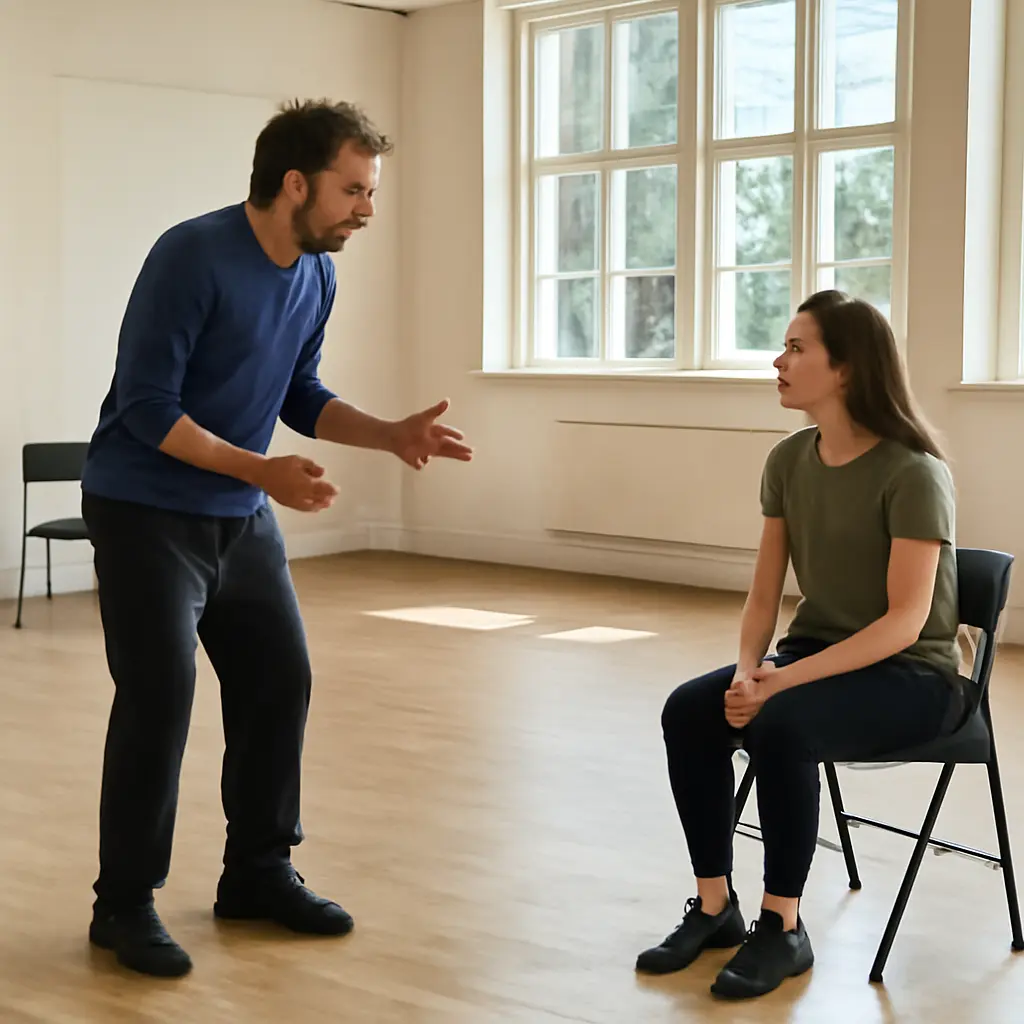
Seasoned improvisers differ from nervous beginners less in talent than in how they respond to uncertainty: they listen closely, accept what has happened, make clear offers, and stay engaged when a scene takes an unexpected turn. Improvisation is the practice of creating performance spontaneously, often with other people; experience helps performers manage its demands through attention, supportive collaboration, and repeated exposure to uncertainty. Research on improvisation and performance anxiety offers useful context, although there is no single statistic that measures the gap between beginner and seasoned improvisers. The key differences are preparation, listening, risk-taking, recovery, and practice.
Experience and improviser confidence
Improvisational confidence is the ability to act and respond without a fully predetermined script, while remaining attentive to fellow performers and the situation. Improvisation researcher and educator Keith Johnstone describes improvisational performance through ideas such as accepting an offer and avoiding unnecessary attempts to control what happens next. In practice, seasoned improvisers are not necessarily free of nerves; they are more practiced at continuing to play while nerves are present.
Improvisation includes several related forms, or hyponyms: theatrical improv, jazz improvisation, comedy games, improvised storytelling, and applied improvisation used in education or workplace training. Each has distinct conventions, but all involve responding in real time. Across these forms, experience tends to shift attention away from “What should I say?” and toward “What is happening, and what can I contribute?”
Preparation without scripting
Preparation for improvisation means developing reusable skills and shared practices rather than memorizing exact lines. Actors may warm up their bodies and voices, practice scene games, or agree on rehearsal principles; jazz musicians may learn harmonic structures and rhythmic vocabulary. These foundations give performers options when the moment arrives without requiring them to predict it.
This distinction helps explain why experienced performers can appear spontaneous while relying on substantial practice. They have rehearsed how to notice, respond, and recover—not the precise content of every future scene. Beginners often mistake spontaneity for having no preparation, then feel exposed when they cannot retrieve a clever line on demand.
Listening and shared attention
Active listening is the practice of taking in a partner’s words, actions, tone, and emotional cues before choosing a response. It gives an improviser material to build on and reduces the pressure to invent an idea alone. In theatre, the response might develop a partner’s location or relationship; in music, it might echo a rhythm or answer a melodic phrase.
Research supports the broader importance of attention in performance: the American Psychological Association’s discussion of performance anxiety describes how intense self-focused attention can interfere with skilled action. This does not mean every nervous performer will falter, but it helps explain a common contrast: beginners may monitor how they look, while more experienced improvisers learn to direct attention outward toward their partners and the task.
How improvisers respond to uncertainty
Once performers are attending to one another, the next difference is how they treat unexpected ideas. A novice may judge an offer before exploring it, trying to find the funniest or safest response. A seasoned improviser is more likely to accept the information, add something specific, and let the scene reveal its possibilities. This approach is not a guarantee of success; it is a way to keep collaboration moving.
Acceptance and building on offers
An offer is any verbal or physical contribution that gives a scene new information. Acceptance means treating that contribution as real within the shared fictional world and responding in a way that adds to it. For example, if a partner says, “The train is leaving,” an improviser might pick up a suitcase and hurry toward the door rather than deny that a train exists.
Johnstone’s influential teaching emphasizes accepting offers because denying them can leave partners with little to work with. Acceptance does not require agreeing with every character or making every idea bigger. It means recognizing the contribution and making a playable next move. Beginners often learn the principle through simple exercises before applying it to complex scenes.
Specificity, risk, and emotional commitment
Specificity is the choice to make a concrete response rather than a vague or generic one. “I’m afraid” may be less useful than “I’m afraid you’ll take the last lifeboat,” because the specific detail gives partners something to explore. Seasoned improvisers also tend to tolerate the possibility that an offer will not land perfectly. They commit to a choice, observe its effect, and adjust.
Risk-taking in improv is not recklessness or disregard for boundaries. It is willingness to make a clear, appropriate contribution without waiting for certainty. The National Institute for Occupational Safety and Health identifies stress as a response to demands that may feel difficult to meet; in performance, a perceived demand to be instantly brilliant can intensify self-consciousness. Clear, manageable choices help redirect effort toward the shared scene.
Mistakes, recovery, and resilience
Recovery is the ability to continue after a missed cue, awkward line, or confusing moment. Experienced improvisers do not need every choice to work: they can acknowledge what happened, listen for the next useful detail, and return to the interaction. Beginners may treat a stumble as proof that the scene has failed, which can make them withdraw or over-explain.
A practical example is a performer who forgets a character’s name. Rather than stopping the scene to apologize repeatedly, the performer can ask a partner for the name in character or use another detail to keep the relationship alive. In music, a player who loses the form can listen for a recurring phrase or rejoin at a clear rhythmic point. In both cases, recovery depends on attention and cooperation more than flawless recall.
Practice that turns nerves into usable energy
Improvisational skill develops through repeated practice in settings where performers can experiment, receive feedback, and try again. Practice does not eliminate nerves; it builds familiarity with the conditions that cause them. The National Institute for Occupational Safety and Health notes that stress responses vary by person and circumstance, so the useful goal is not to demand fearlessness but to develop reliable ways of working under pressure.
Repetition, feedback, and deliberate play
Deliberate practice involves working on a particular skill, noticing what happens, and making adjustments. An improv student might focus on accepting offers for one exercise, then practice adding specific details in another. A jazz musician might isolate a transition or listen back to recordings. Feedback is most helpful when it identifies an actionable behavior—such as “leave space after your partner’s line”—rather than labeling someone as naturally talented or untalented.
A relevant real-world example comes from ensemble rehearsal. When a group routinely practices handing focus to different performers, members become less dependent on one person to rescue every scene. The group gains more ways to respond to a weak moment, and each performer can concentrate on the shared task instead of carrying the entire performance alone.
Managing performance anxiety
Performance anxiety is worry or physical tension associated with being evaluated while performing. It can affect beginners and experienced artists alike. Practical approaches include warming up, slowing the breath, setting a process-focused goal, and directing attention to a partner or musical phrase. These strategies are not substitutes for professional support when anxiety is severe or persistent, but they can make ordinary performance nerves easier to manage.
The American Psychological Association’s materials on anxiety and performance describe how anxiety can influence attention and behavior. For improvisers, this makes process goals especially useful: “listen for one detail,” “make one clear offer,” or “stay connected after a mistake.” Such goals are more controllable than “be funny” or “never freeze,” and they give performers a concrete next step.
Conclusion: experience means staying available
What separates seasoned improvisers from nervous beginners is not an absence of fear or a supply of perfect ideas. It is a practiced ability to prepare without scripting, listen with shared attention, accept and develop offers, take appropriate risks, and recover when a choice does not work. Repetition, supportive feedback, and manageable performance strategies help make those behaviors more dependable.
For anyone learning improv, the most useful next step is to practice one behavior at a time: listen for a concrete detail, accept a partner’s contribution, or stay engaged after a mistake. These habits matter beyond the stage, too, because they support collaboration in music, classrooms, meetings, and everyday conversation. Further reading on Keith Johnstone’s improvisation methods and the American Psychological Association’s resources on performance anxiety can help connect practical exercises with broader research.
Sources: Keith Johnstone, Impro: Improvisation and the Theatre, https://www.routledge.com/Impro-Improvisation-and-the-Theatre/Johnstone/p/book/9780878301171; American Psychological Association, Performance Anxiety, https://www.apa.org/topics/anxiety/performance-anxiety; National Institute for Occupational Safety and Health, Stress at Work, https://www.cdc.gov/niosh/docs/99-101/