
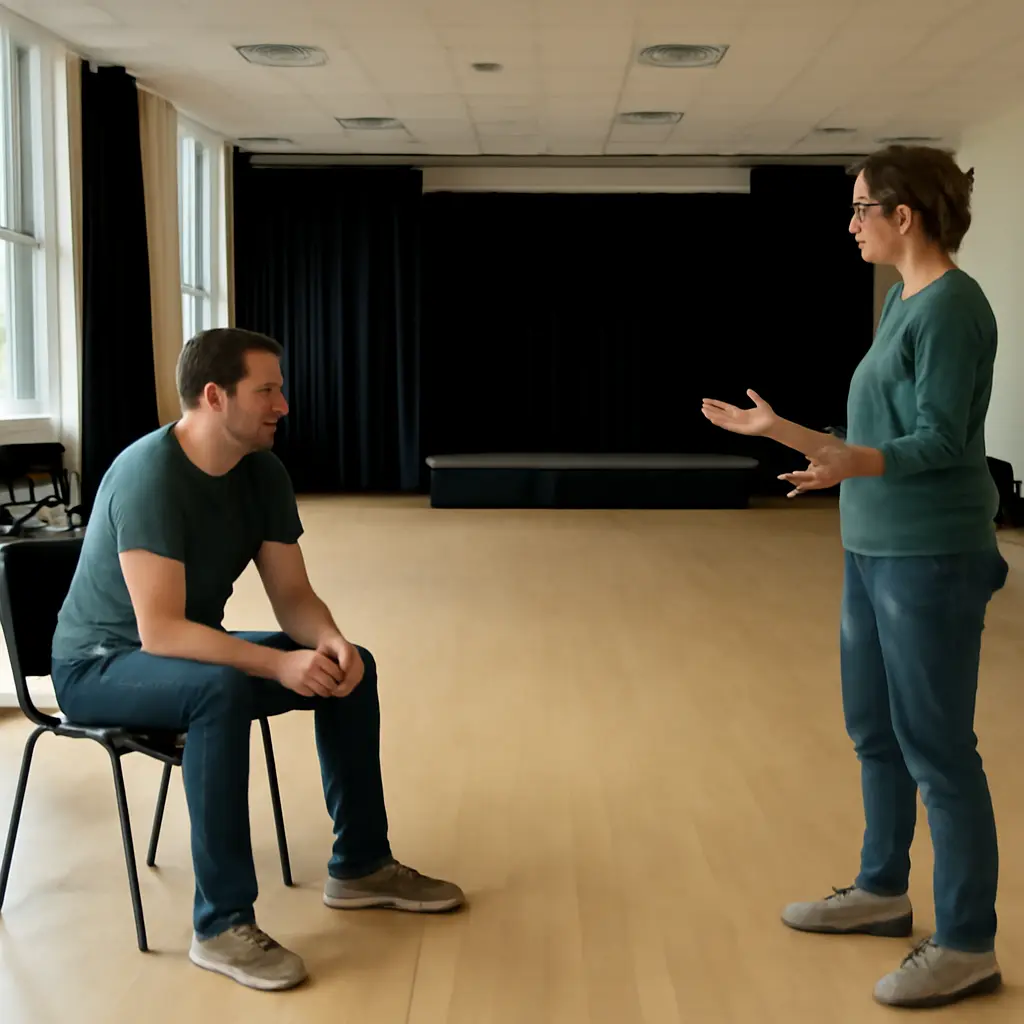
Seasoned improvisers and nervous beginners both face the same uncertainty: they do not know exactly what will happen next. The difference is less about being naturally quick or funny than about how they respond to that uncertainty. Experienced improvisers tend to listen closely, accept offers, build on what a partner gives them, and recover when a scene goes off course; beginners are more likely to plan their next line, judge their performance, or try to force a clever result. Research on improvisation and group creativity supports the value of preparation, attentive collaboration, and psychological safety, though it does not establish one universal formula for stage success. These habits matter beyond comedy, too: improvisation is used in theatre, music, education, and workplaces whenever people must adapt in real time.
Improvisational skill is built on listening and response
Improvisation is the creation of action, dialogue, or music in the moment, without a fully fixed script or plan. In theatre, improvisation educator and author Viola Spolin described improvisation as a way of learning through experience and play, with attention directed toward the shared activity rather than toward self-conscious evaluation. That distinction helps explain why seasoned performers often appear relaxed: they are not necessarily free of nerves, but they have practiced turning attention outward toward the scene and their partners.
Improvisation includes several related forms: theatrical scene work, short-form games, long-form performance, musical improvisation, and applied improvisation used in settings such as education or workplace training. Each has different conventions, but all require performers to notice what is happening, make a choice, and adjust to new information. A 2014 study by Charles Limb and Allen Braun, published in PLOS ONE, used brain imaging to examine jazz improvisation and reported changes in activity associated with spontaneous generation and self-monitoring. The finding does not mean that performers can simply switch off judgment; it suggests that creative flow involves a different balance of processes than tightly monitored performance.
Listening before trying to be clever
Listening in improvisation means taking in a partner’s words, movement, tone, and emotional intention before deciding what to add. A beginner who is busy rehearsing a punchline may miss a useful detail; an experienced performer can treat that detail as material for the next beat. This is active listening, not passive silence: the performer registers an offer and responds in a way the audience can follow.
The principle is especially visible in ensemble scenes. If one actor establishes that a character is frightened of the dark, a partner can deepen the reality of that fear rather than replacing it with an unrelated gag. The more clearly performers attend to one another, the less they need to invent in isolation. This makes listening both a creative tool and a practical way to reduce the pressure of having to produce an impressive line from nothing.
Accepting and building on offers
An offer is any verbal or physical contribution that gives a scene information or direction. The familiar “Yes, and” principle means accepting the basic reality a partner has introduced and adding something that advances it. It is not a demand to agree with every statement in ordinary life; it is a stage technique for maintaining shared reality and momentum.
For example, if a performer says, “The spaceship is losing power,” a partner might answer, “I’ll divert the emergency batteries to the navigation system.” The response accepts the spaceship and its problem while adding a playable next step. Beginners may deny the premise, change the subject, or introduce a competing idea because they are trying to control the scene. Seasoned improvisers more often build on what is already there, giving their partners something clear to work with.
Practice turns uncertainty into playable choices
Improvisational confidence is not the same as certainty about what will happen. It is the capacity to keep making useful choices when the outcome is unknown. Repetition helps because performers encounter common challenges—silence, conflicting ideas, unclear settings, and mistakes—often enough to respond without treating each one as a crisis. In a 2010 review in the journal Psychological Science in the Public Interest, K. Anders Ericsson emphasized deliberate practice as a structured process involving focused effort, feedback, and work on specific weaknesses. That framework is not a claim that every kind of expertise develops identically, but it helps distinguish purposeful rehearsal from simply accumulating stage time.
Training also connects improvisation to broader research on creative groups. A 2012 study by Tina Seelig and colleagues at Stanford’s Hasso Plattner Institute of Design examined improvisational theatre exercises as a way to support creativity and collaboration among students. Such work suggests that improvisation can be studied as a set of learnable behaviors, although results from educational exercises should not be treated as a direct measure of professional stage performance.
Repetition, feedback, and a toolkit of skills
A toolkit is a collection of practiced options: establishing a location, clarifying a relationship, heightening a pattern, making a specific choice, or helping a partner recover. Beginners may assume that experienced performers never get stuck. More often, experienced performers have rehearsed ways to respond when they do. They can return to a clear relationship, use an object or setting already introduced, or ask a grounded question that gives the scene direction.
Useful practice is specific. Rather than repeating scenes with only the goal of “being funnier,” a group can work on making the first choice clear, listening without interrupting, or sustaining a premise for several beats. Feedback should identify observable behavior—such as whether a performer used a partner’s detail—rather than label someone as talented or untalented. This helps make improvement concrete and gives beginners a path forward.
Comfort with mistakes and recovery
Recovery is the ability to continue after a missed cue, an awkward line, or an idea that does not land. Seasoned improvisers do not have to pretend that every choice works; they avoid making one imperfect moment the entire scene’s problem. They may acknowledge the unexpected detail, connect it to the existing situation, or simply make a new choice and move on.
This ability is supported by the group’s social environment. Harvard Business School professor Amy Edmondson defines psychological safety as a shared belief that a team is safe for interpersonal risk-taking. In her 1999 study of work teams, she linked psychological safety with learning behavior, including asking questions and discussing errors. The research concerned organizational teams, not improv troupes specifically, but the connection is relevant: performers are more likely to experiment when a group treats mistakes as information rather than grounds for humiliation.
Experienced improvisers manage attention, not just nerves
Stage nerves are a normal response to being watched and evaluated. The useful difference is how performers handle that pressure. Beginners often focus on self-monitoring—“Am I funny? What should I say? Did that fail?”—which can crowd out attention to partners and the scene. Experienced performers are more likely to direct attention toward a concrete task: identify the relationship, notice a change in tone, or make the next choice easy for a partner to understand.
The American Psychological Association’s discussion of performance anxiety describes how excessive concern about evaluation can interfere with performance. This does not mean that confidence requires eliminating anxiety. Instead, preparation and attention-management strategies can help performers act while nervous. The contrast is therefore not “fearful beginner versus fearless expert”; it is often “self-focused uncertainty versus practiced engagement with the scene.”
Choosing clarity over a forced laugh
A clear choice gives the scene a recognizable person, relationship, setting, or problem. A forced laugh is an attempt to produce a joke regardless of whether it fits. Seasoned improvisers may still make jokes, but they tend to let humor emerge from the situation rather than interrupting the shared reality to display cleverness. Specificity helps: “I’m worried about the test” gives a partner less to work with than “I’ve memorized the entire driving manual, but I still can’t parallel park.”
Clarity also helps the audience follow the scene. When performers establish who they are to each other and what matters, later surprises have context. A deliberate pause, a repeated behavior, or a small change in status can be more effective than a rapid sequence of unrelated jokes. This is one reason experienced performers can appear less frantic: they trust a developed idea enough to let it breathe.
Responding to partners and the room
Improvisation is collaborative, so performers continuously adjust to one another and to the audience. A laugh, silence, or visible confusion may affect pacing, but it should not cause the performers to abandon the scene’s logic. Seasoned improvisers notice audience response while staying committed to their partners. Beginners may chase a laugh by repeating a joke or changing direction too quickly, which can weaken the shared structure.
The same responsiveness matters in music. Jazz musicians listen for rhythm, phrasing, and harmonic changes, then shape their contributions around the ensemble. The National Endowment for the Arts has documented the broad reach of jazz in the United States through its arts participation research, while studies of musical improvisation show that the practice involves both individual invention and responsiveness to other musicians. The stage and musical examples differ in technique, but both demonstrate that improvisation is a conversation, not a solo test of speed.
What beginners can practice to become more seasoned
A beginner does not need to wait for confidence before participating. Confidence often follows repeated, manageable experiences of listening, contributing, and recovering. The most useful training targets are behaviors that can be observed and practiced, rather than vague goals such as “be naturally spontaneous.”
A practical progression for rehearsal
- Begin with short listening exercises in which each performer repeats or uses one specific detail from a partner.
- Practice accepting a premise and adding one new piece of information, without trying to resolve the entire scene immediately.
- Build scenes around a clear relationship or activity before adding complications.
- Repeat a scene with one focused goal, such as making stronger physical choices or giving partners more space to contribute.
- After each exercise, discuss what was observable: which offers were accepted, what information became useful, and how the group recovered from uncertainty.
This progression makes the learning process safer and more measurable. It also reflects a central lesson from research on practice and team learning: improvement is more likely when people receive useful feedback and can take interpersonal risks without being shamed. A class or troupe can reinforce that environment by treating a scene’s unsuccessful choices as material for analysis, not as evidence that a performer does not belong.
Conclusion: seasoned improvisers trust the process
What separates seasoned improvisers from nervous beginners is not the absence of fear or the constant production of brilliant ideas. It is a learned way of working: listen before responding, accept and develop offers, make clear choices, practice deliberately, and recover without turning mistakes into emergencies. These habits connect improvisational performance with wider ideas about creative practice, collaboration, and psychological safety.
For anyone learning to improvise, the practical next step is to focus on one behavior at a time and rehearse it with supportive partners. Watch a scene for how performers use one another’s details, not only for how many laughs it earns. The more attention shifts from proving oneself to building something together, the more manageable uncertainty becomes.
Sources: Viola Spolin, Improvisation for the Theater: A Handbook of Teaching and Directing Techniques, Northwestern University Press, https://nupress.northwestern.edu/9780810140080/improvisation-for-the-theater/; Charles J. Limb and Allen R. Braun, “Neural Substrates of Spontaneous Musical Performance: An fMRI Study of Jazz Improvisation,” PLOS ONE, 2008, https://doi.org/10.1371/journal.pone.0001679; K. Anders Ericsson, “The Acquisition of Expert Performance as Problem Solving: Construction and Modification of Mediating Mechanisms through Deliberate Practice,” Psychological Science in the Public Interest, 2010, https://doi.org/10.1177/1529100610376661; Tina Seelig et al., “The Innovation Engine: A Case Study of the Stanford d.school’s Methods for Developing Creativity,” Stanford University, https://dschool.stanford.edu/resources; Amy C. Edmondson, “Psychological Safety and Learning Behavior in Work Teams,” Administrative Science Quarterly, 1999, https://doi.org/10.2307/2666999; American Psychological Association, “Performance Anxiety,” https://www.apa.org/topics/anxiety/performance-anxiety; National Endowment for the Arts, Arts Participation Patterns in 2022: Highlights from the Survey of Public Participation in the Arts, https://www.arts.gov/impact/research/publications/arts-participation-patterns-2022-highlights-survey-public-participation-arts.